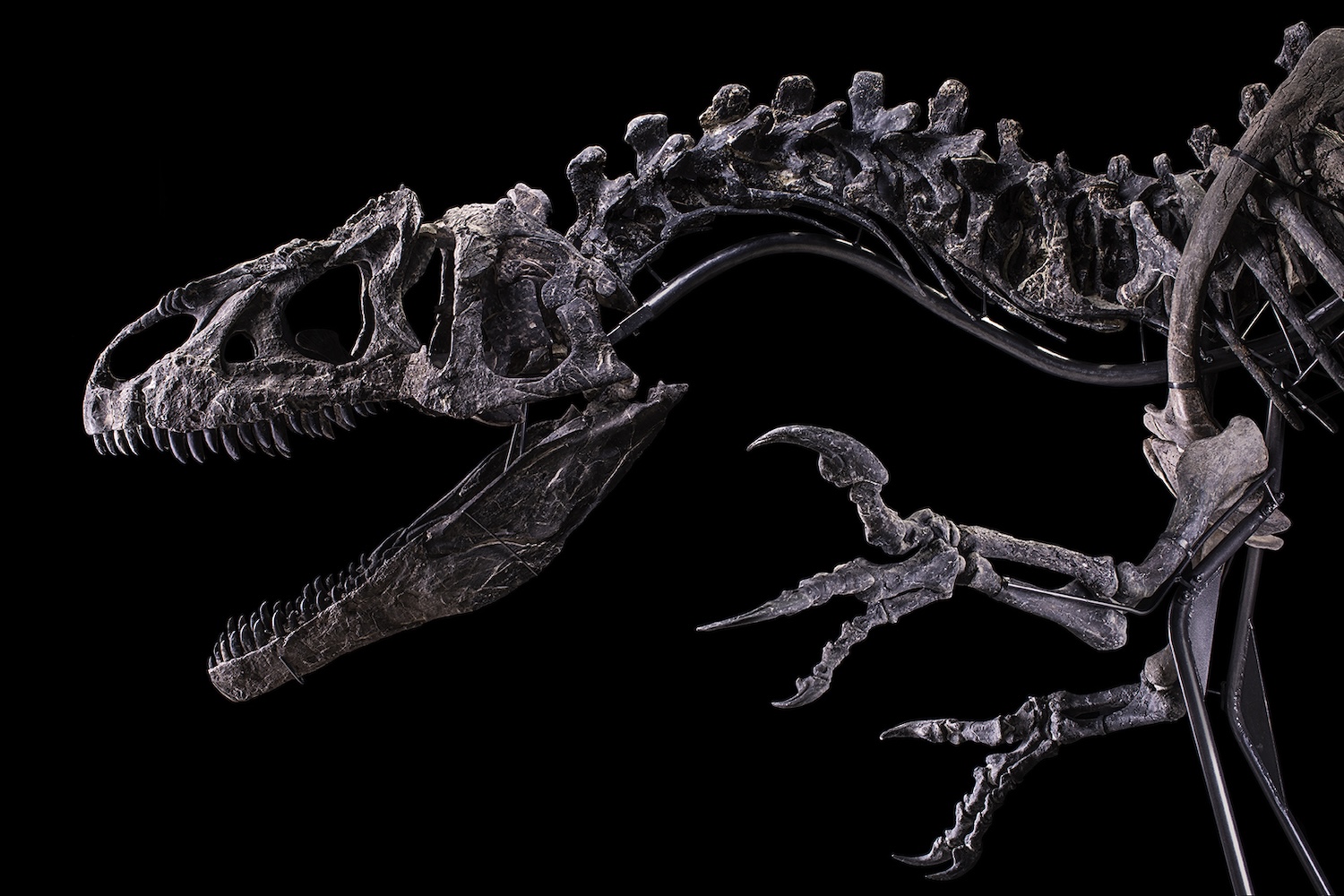
The large Allosaurus worked by Zoic on display today at
The Etches Collection.
A dinosaur prepared in our workshops now on public display in Dorset, UK.
"Big Sara" represents the largest dinosaur ever exhibited at the Etches Collection and offers visitors a close encounter with one of the great predators of the Jurassic period.
There is a very special moment in working with fossils: the moment when a specimen, after years of study, preparation and reconstruction, finally finds its place in front of the public.
That is exactly what is happening with "Big Sara," a spectacular Allosaurus sp. skeleton now on temporary display at The Etches Collection - Museum of Jurassic Marine Life, in Dorset, UK.
The dinosaur has been on loan to the museum for two years from The Richmond Group, allowing visitors to get an up-close look at one of the most iconic Jurassic predators.


PRESS RELEASE.
For Zoic, this exhibit is a source of great pride: the specimen was processed, assembled, and reconstructed in our laboratories between 2019 and 2020, through a process that involved paleontological preparation, anatomical reconstruction, and exhibit design.
A large Jurassic predator
"Big Sara" is a skeleton of Allosaurus sp., one of the best-known carnivorous dinosaurs of the Upper Jurassic.
The specimen is from the famous Morrison Formation in Wyoming, USA, and is dated to about 150 million years ago.
At nearly 10 meters long and over 3.5 meters tall, it represents one of the most impressive specimens ever exhibited in the Dorset region and the largest dinosaur ever presented to the public at the Etches Collection.
PRESS RELEASE.
According to the museum, it is also the first large theropod dinosaur housed in their galleries and the only true Allosaurus skeleton currently visible in the UK.
PRESS RELEASE.
The work behind a museum skeleton
When a large dinosaur enters a museum, the public sees the end result: an imposing structure that immediately returns the image of an animal that lived millions of years ago.
Behind that stage presence, however, there is a lot of technical work.
Between 2019 and 2020, Zoic followed the process of working on the specimen, taking care of the preparation, reconstruction of missing parts, and assembly of the skeleton, with the goal of achieving a stable structure and a scientifically legible dynamic pose.
As is often the case with large fossil vertebrates, the skeleton combines original bones with reconstructed parts in missing areas, a practice that allows the public to be given a complete view of the animal while maintaining the distinction between authentic material and additions.


PRESS RELEASE.
This type of intervention requires a combination of different skills:
- paleontological preparation
- anatomical reconstruction
- structural engineering
- exhibition design
These are all elements that allow a fossil to move from the laboratory to the museum dimension.
From the laboratory to the museum
After attracting international interest in previous years, the specimen was acquired by The Richmond Group, which chose to make it accessible to the public through loan to the museum.
This step represents a key moment in the life of a great fossil: when an artifact becomes a cultural and scientific experience for the public.
For those who work with these specimens, seeing the end result in a museum is one of the most rewarding moments.
It means knowing that the work done in the laboratory contributes to a direct encounter between the public and the deep history of life on Earth.


The value of paleontological work
For Zoic, projects like this perfectly represent a central part of our business.
Our work also involves preparing, reconstructing, and mounting exceptionally important paleontological specimens, accompanying them to museum destinations or collections that will enable their cultural enhancement.
All finds are processed in accordance with a responsible acquisition chain that complies with regulations governing the fossil trade, ensuring transparency and traceability.
When a dinosaur such as "Big Sara" finds a space in a museum open to the public, our work acquires an additional dimension: that of scientific popularization and enhancement of natural history.
A dinosaur that continues to tell its story
Today "Big Sara" welcomes visitors to the Etches Collection by offering a firsthand look at one of the great predators that populated the planet some 150 million years ago.
It gives us great satisfaction to know that a specimen worked in our workshops can be observed and admired by thousands of visitors.
In this sense, "Big Sara" is not just a big dinosaur on display.
It is the result of a journey that combines research, technical expertise and museum vision-a journey that allows an extraordinary fossil to live on in public space, generating wonder, knowledge and curiosity about the history of life on Earth.
YouTube: The Etches Collection - YouTube
Facebook: The Etches Collection | Facebook
Twitter: The Etches Collection (@TEC_Kimmeridge) / Twitter
Instagram: The Etches Collection (@tec_kimmeridge) - Instagram photos and videos